


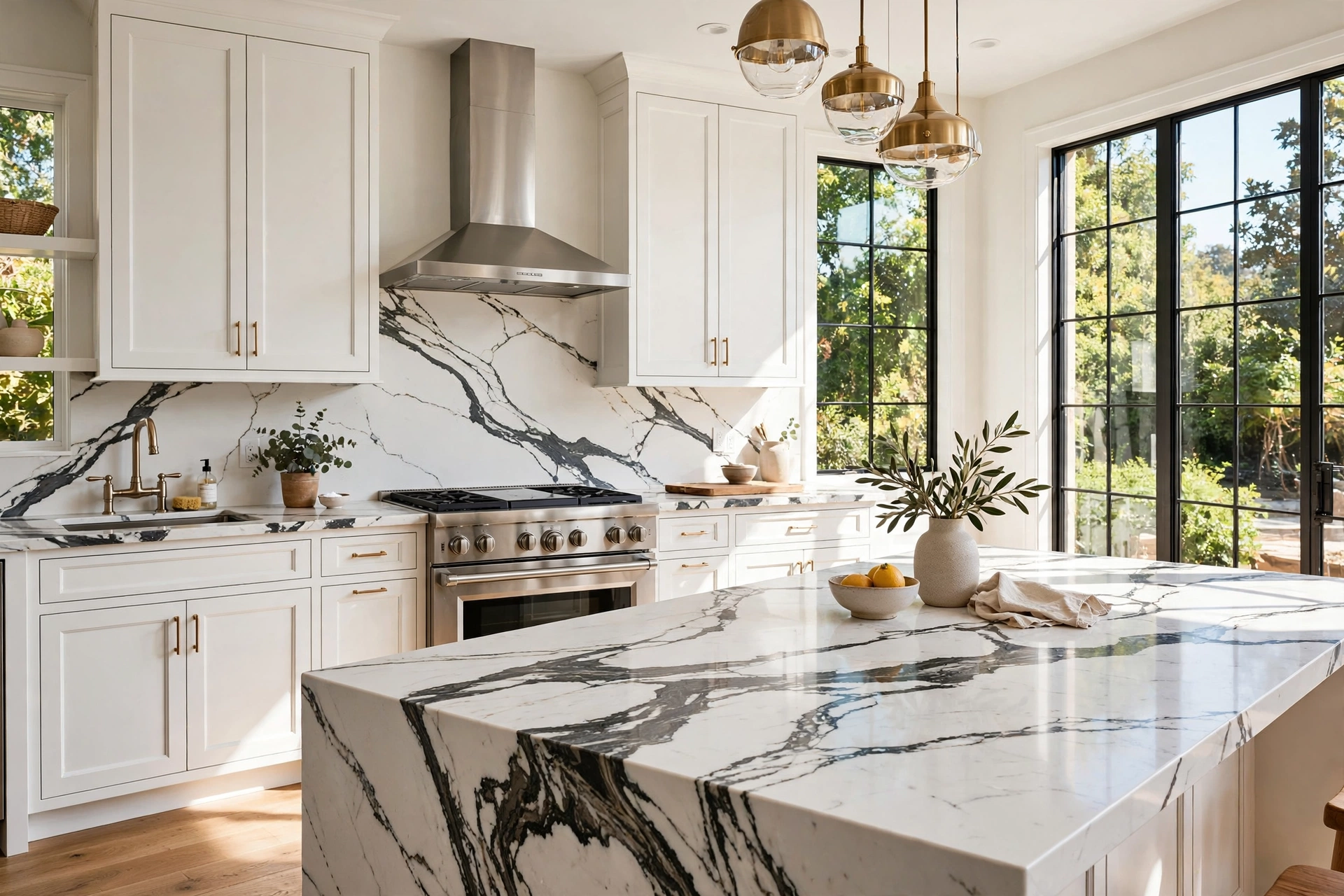
Walk into any kitchen showroom in New Jersey and you will hear the same debate: quartz vs granite countertops. They are the two most popular stone surfaces in American kitchens, they cost roughly the same installed, and homeowners argue about them like sports teams. So which one actually belongs in your kitchen?
The honest answer is that both are excellent, but they win at different things. Quartz wins on consistency and low maintenance. Granite wins on natural beauty and heat tolerance.
The right choice depends on how you cook, how you clean, and what your kitchen needs to look like every morning for the next twenty years.
In this guide, we compare quartz vs granite countertops head to head: looks, durability, heat and stain resistance, maintenance, and real 2026 installed prices in northern and central New Jersey.
By the end, you will know exactly which stone to pick.
The Short Answer: Quartz vs Granite Countertops at a Glance
If you want the quick version before the details: choose quartz if you want a countertop that looks the same every day, never needs sealing, and shrugs off coffee, wine, and tomato sauce.
Choose granite if you love the one-of-a-kind character of natural stone, you set hot pans down without thinking, and you do not mind resealing once a year.
On price, they are closer than most people expect. In New Jersey in 2026, installed quartz typically runs $75 to $120 per square foot, while installed granite runs $60 to $110 per square foot.
For an average kitchen needing 40 to 50 square feet, that puts most projects between $3,000 and $6,000 either way. The material itself rarely decides the budget.
Edge profiles, sink cutouts, and whether the backsplash is included move the final number more than quartz versus granite does.
Still reading? Good. The details are where the right decision lives.
What Exactly Is Quartz?
Quartz countertops are engineered stone, not slabs cut straight from the earth. Manufacturers crush natural quartz crystals (about 90 to 95 percent of the slab) and bind them with polymer resins and pigments, then press the mixture into slabs under intense heat and pressure.
Because it is manufactured, quartz gives you something natural stone cannot: total consistency. The sample you approve in the showroom is what shows up at your house.
The veining, the color, the pattern repeat exactly. For homeowners who have been burned by a natural slab that looked different in daylight than it did under showroom lights, that predictability is a genuine relief.
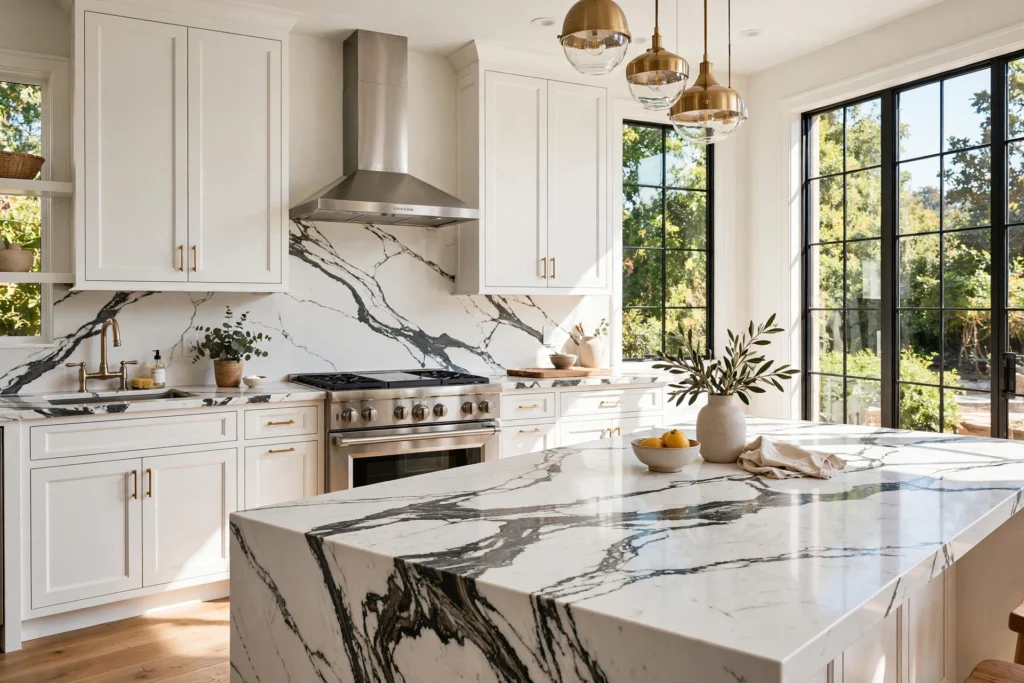
Modern quartz also does a remarkable impression of marble. Manufacturers now run deep, soft veining through the full thickness of the slab, so a quartz that mimics Calacatta marble can fool most guests.
It will not fool a stone expert inspecting it up close, but from two feet away at a dinner party, nobody is checking.
One thing quartz is not: fully heat-proof, and it is not the right pick for an outdoor kitchen. We will get to both of those.
What Exactly Is Granite?
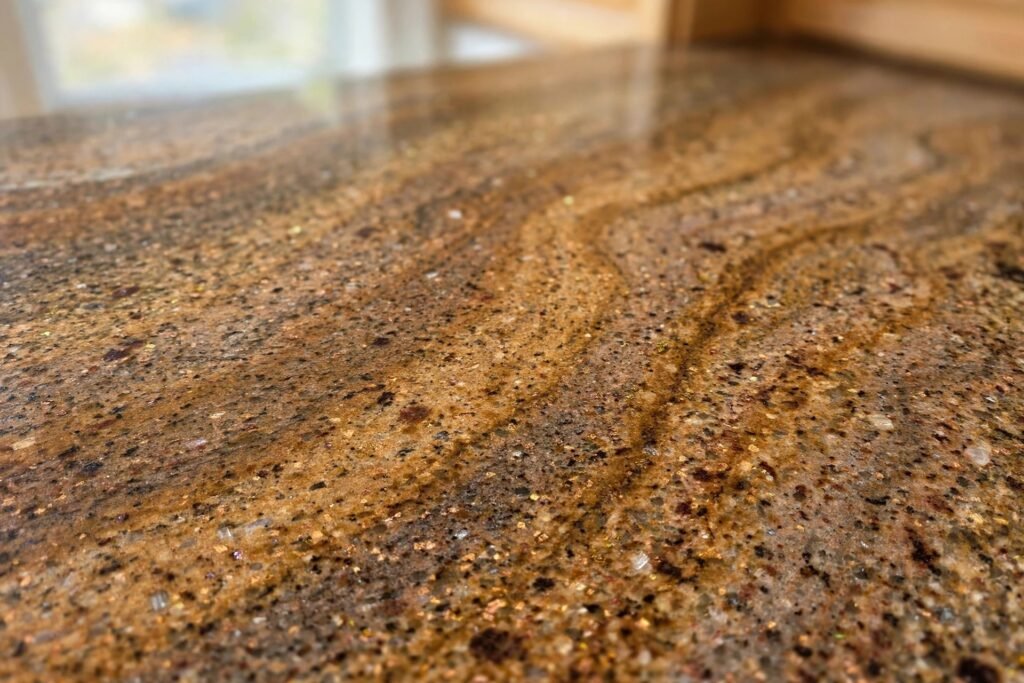
Granite is 100 percent natural stone, formed over millions of years as magma cooled slowly beneath the earth’s surface. Quarries cut enormous blocks from the ground, slice them into slabs, polish them, and ship them around the world.
Popular varieties come from Brazil, India, Italy, and parts of Africa, and each quarry produces stone with its own personality.
That natural origin is granite’s whole appeal. No two slabs are identical. The mineral flecks, the sweeping veins, the clouds of color: your countertop is literally one of a kind.
Homeowners who choose granite usually describe the moment they fell for their slab the way people talk about falling for a house. You walk the slab yard, one piece stops you in your tracks, and the decision makes itself.
The trade-off for that uniqueness is variability. The small sample in the showroom is only a hint of what the full slab looks like.
Reputable fabricators in New Jersey will take you to see and approve your actual slabs before cutting, and you should always say yes to that trip. It is the only way to know exactly what is going into your
kitchen.
Quartz vs Granite: Head-to-Head Comparison
Now the real comparison. We will score the categories that matter in a working kitchen, not a showroom.
| Category | Quartz | Granite | Winner |
|---|---|---|---|
| Appearance | Consistent, huge design range | Unique natural character | Tie |
| Scratch resistance | Very hard, resin binders | Slightly harder (Mohs 6-7) | Granite |
| Heat resistance | Can scorch, use trivets | Handles hot pans with ease | Granite |
| Stain resistance | Non-porous, best in class | Porous, needs sealing | Quartz |
| Maintenance | Soap and water, no sealing | Reseal yearly (~20 min) | Quartz |
| Entry-level cost | $75+/sq ft installed | $60+/sq ft installed | Granite |
| Lifespan | 25+ years | 25+ years | Tie |
| Resale value | Timeless neutrals win | Timeless neutrals win | Tie |
Appearance
Quartz offers consistency and an enormous design range. Because it is engineered, you can get pure whites, warm greiges, concrete looks, and marble imitations with soft, realistic veining.
If your kitchen design depends on a specific shade matching your cabinets, quartz is the safer bet.
Granite offers character that cannot be manufactured. Deep blacks with silver mineral flecks, dramatic blue-golds, warm earthy browns with movement that shifts as light moves across it.
If you want your kitchen to have a centerpiece that no one else has, granite wins this round.
Winner: tie. It comes down to whether you value precision or personality.
Durability and Scratch Resistance
Both are hard, daily-use surfaces, but granite has a slight edge in raw hardness. Granite ranks around 6 to 7 on the Mohs hardness scale.
Quartz is also very hard, but the resin binders make it a touch more vulnerable to a determined knife dragged across it.
In practice, neither surface should be used as a cutting board. A little discipline with a cutting board keeps both looking new for decades.
But if someone in your house treats the counter like a cutting board anyway, granite forgives slightly more.
Winner: granite, by a small margin.
Heat Resistance
This is granite’s clearest win. Granite is formed by heat and pressure, so a hot pan straight from the burner will not faze it.
Trivets are still smart (extreme thermal shock can crack any stone), but granite handles everyday heat with ease.
Quartz is the one you have to be careful with. The polymer resins in quartz can scorch or discolor under high heat. A hot pot set directly on quartz can leave a mark that does not come out.
If you are the kind of cook who moves pans around without thinking, this matters more than any other category in this guide.
Winner: granite, decisively.
Stain Resistance
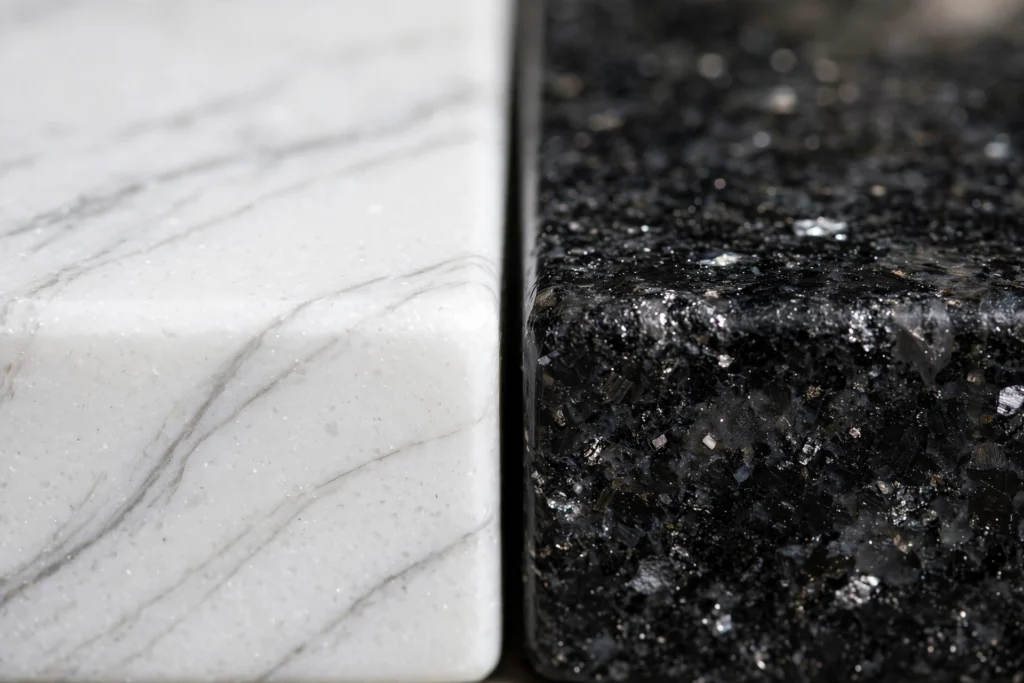
Quartz wins here, and it is not close. Because quartz is non-porous, coffee, red wine, olive oil, and turmeric sit on the surface instead of soaking in.
Wipe them up when you get to them and there is no story to tell.
Granite is porous stone. Sealed granite resists stains well in normal use, but it is not invincible. Leave red wine or cooking oil sitting overnight on a light-colored granite and you may be making a poultice paste the next morning.
Dark granites hide this risk better than light ones, which is worth knowing when you fall in love with a pale slab.
Winner: quartz, decisively.
Maintenance
Quartz asks almost nothing of you. Soap, water, a soft cloth. No sealing, ever. Avoid abrasive pads and harsh chemicals, and you are done.
For busy families, this is the single biggest practical advantage quartz has.
Granite asks for a little ritual: resealing about once a year with a penetrating sealer, which takes twenty minutes and costs very little. Daily cleaning is the same soap and water.
Skip the vinegar and lemon-based cleaners, which can dull the finish over time.
The Natural Stone Institute’s guidance on granite vs engineered quartz is a good reference for what natural stone actually needs, and it is less than most people fear.
Winner: quartz, for zero sealing. But granite’s maintenance is a small annual task, not a burden.
Cost: What Quartz vs Granite Countertops Cost in New Jersey
Let us talk real numbers, because this is where showroom myths die. In northern and central New Jersey in 2026, quartz vs granite countertops installed prices look like this:
| Material | Installed price per sq ft | Typical 45 sq ft kitchen |
|---|---|---|
| Quartz (standard colors) | $75 to $95 | $3,400 to $4,300 |
| Quartz (premium/marble-look) | $95 to $120+ | $4,300 to $5,400+ |
| Granite (common colors) | $60 to $85 | $2,700 to $3,800 |
| Granite (exotic colors) | $85 to $110+ | $3,800 to $5,000+ |
A few things these ranges do not show. First, common granite colors like Ubatuba or Santa Cecilia can undercut quartz noticeably, which is why budget-conscious shoppers often land on granite.
Second, premium quartz with realistic marble veining can cost more than most granites.
Third, the extras add up the same for both: an ogee or waterfall edge, a farmhouse sink cutout, and a full-height stone backsplash can add $800 to $2,000 to either material.
Our countertop and backsplash page shows the full range of what we fabricate and install across Essex, Somerset, and Hunterdon counties, including current edge and finish options.
Winner: granite, slightly, on entry price. At the premium end, it is a wash.
Lifespan
Both last decades. A well-cared-for granite or quartz countertop will still be going strong in 25 years. Granite’s very hardness gives it a theoretical edge in longevity.
But in real kitchens, what ends a countertop’s life is usually a renovation, not wear. Call this one a tie.
Resale Value
Here is something NJ sellers should know: in our market, buyers respond to the overall kitchen, not the stone’s pedigree.
A beautiful quartz countertop in a well-designed kitchen adds exactly as much resale appeal as a beautiful granite one.
What hurts resale is a dated or damaged countertop of any material, or a bold exotic granite that only you loved. If resale is on your mind within five years, pick a timeless, neutral stone in either material and spend your energy on the cabinets and layout around it.
Winner: tie.
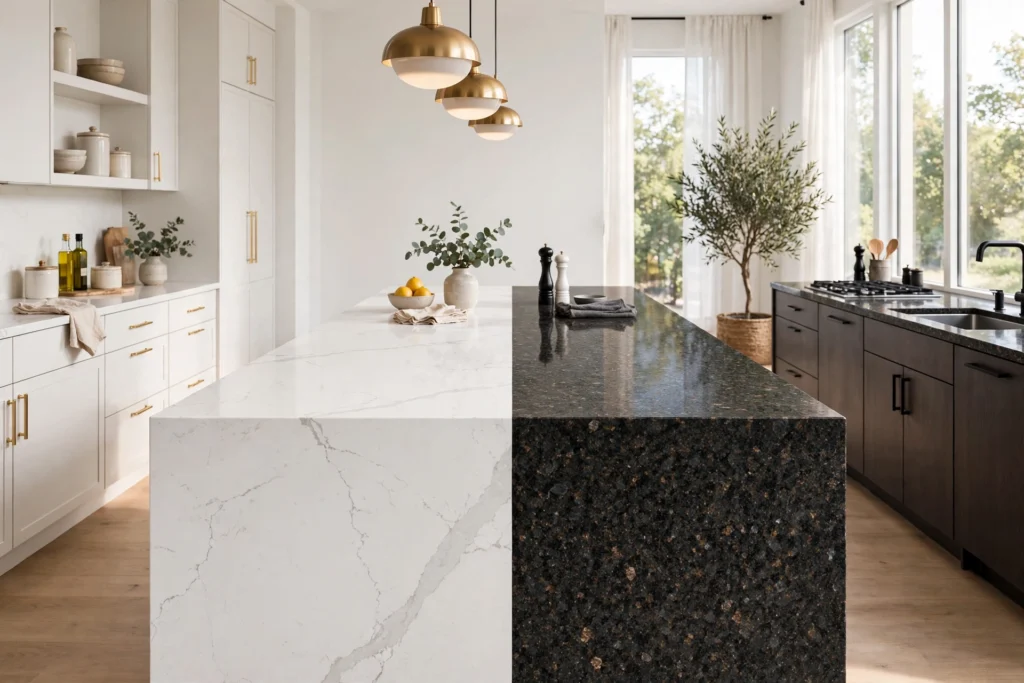
Quartz vs Granite Countertops: Which Should You Choose? (A 60-Second Decision Guide)
Forget the showroom debate for a moment and answer these honestly:
Choose quartz if: you have young kids and the counter doubles as a homework station; you cook with turmeric, red wine, or tomato sauce regularly; you want zero maintenance.
Also choose quartz if your design needs an exact color match, or you just do not want another household chore on the list.
Choose granite if: you are a serious cook who moves hot pans without thinking; you fell in love with a specific slab and cannot stop thinking about it.
Also choose granite if you like materials with natural variation, or you want the lowest entry price for real stone.
Still torn? Visit a slab yard and look at full slabs of quartz vs granite countertops, not samples. Most homeowners know within ten minutes of standing in front of real stone.
In our area, slab yards in Newark, Edison, and Bridgewater carry deep selections of both, and any reputable fabricator will walk them with you before you commit.
One more practical note: whichever you choose, pair it thoughtfully with the rest of the kitchen. A stunning stone next to tired oak cabinets is a mismatch.
Many of our clients time their countertop upgrade with cabinet refacing, which gives the whole kitchen a cohesive, brand-new look for far less than a full replacement.
Quartz vs Granite: Myths Worth Clearing Up
“Granite is dangerously porous and harbors bacteria.” Overstated. Sealed granite cleaned with soap and water is a perfectly hygienic food surface, and it has been for decades.
Quartz’s non-porous surface is easier to keep pristine, but granite is not a health hazard.
“Quartz is maintenance-free.” Nearly, but not entirely. It never needs sealing, true. But heat damage is permanent, and harsh chemicals can dull the finish.
Low maintenance is not the same as indestructible.
“Granite needs constant resealing.” Once a year, twenty minutes. That is the whole ritual. Some dense, dark granites go years between sealings.
Ask your fabricator about your specific stone.
“Quartz looks fake.” Ten years ago, fair criticism. Today’s premium quartz with through-body veining looks remarkably like marble.
Budget quartz still has that flat, printed look, so the price tier matters here.
“You can set hot pans on quartz just like granite.” Please do not. This is the single most expensive misconception in the quartz world.
Trivets are cheap. A scorched quartz countertop is not.
Quartz vs Granite Countertops: Frequently Asked Questions
Is quartz or granite better for kitchens?
Neither is universally better. Quartz is better for stain resistance and zero maintenance. Granite is better for heat resistance and natural character. The right pick depends on your cooking habits and how much maintenance you will actually do.
Which is cheaper, quartz or granite?
Common granite colors are usually the cheapest stone option, starting around $60 per square foot installed in NJ. Standard quartz starts a bit higher, around $75. Premium versions of both overlap heavily in the $95 to $120 range.
Does granite need to be sealed every year?
Most granite benefits from resealing about once a year with a penetrating sealer. It takes about twenty minutes. Dense, dark granites may go longer between sealings. Your fabricator can advise based on your specific stone.
Can you put hot pans on quartz countertops?
You should not. The resins in quartz can scorch or discolor under high heat, and the damage is permanent. Always use trivets or hot pads on quartz. Granite handles hot pans far better.
Does quartz look like real marble?
Premium quartz with through-body veining comes remarkably close to marble’s look, close enough to fool most guests. It will not have marble’s depth and natural variation up close, but as a practical marble alternative, it is the best option available.
How long do quartz and granite countertops last?
Both routinely last 25 years or more with normal care. In practice, countertops are usually replaced during the next renovation, not because they wore out.
See Quartz vs Granite Countertops in a Real Kitchen Before You Decide
Photos and samples only go so far. The best way to choose between quartz vs granite countertops is to see full slabs in person and talk through your cooking habits with someone who installs both every week.
Kitchen Remodeling New Jersey has been designing and installing kitchens across Essex, Somerset, and Hunterdon counties since 2013.
Book a free 3D design consultation and we will help you compare real quartz vs granite countertops for your space, with fixed line-item pricing and no pressure.
Explore our kitchen remodeling services or browse more guides on our blog to keep planning.